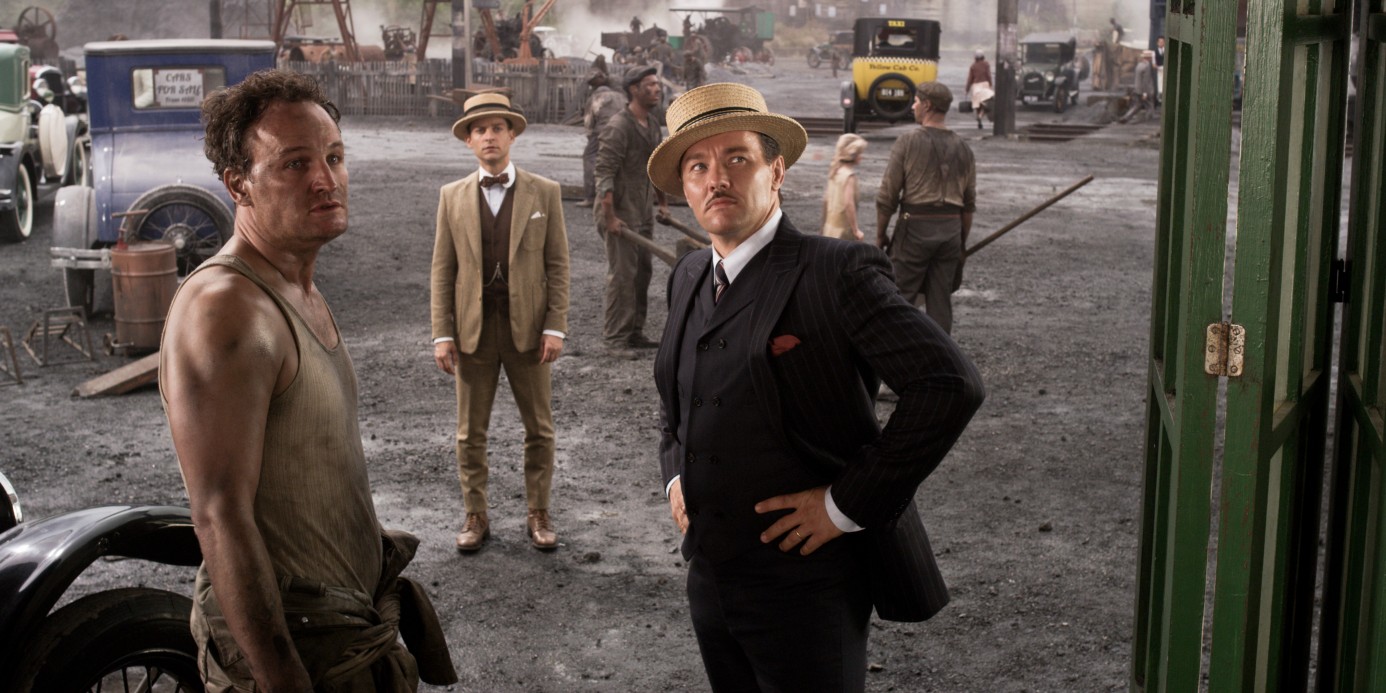
Chapter 9

The “Endless Drill” & Wilson

After Gatsby’s death, Nick describes the events as an “endless drill” of reporters coming in to glance at Gatsby’s body; keep in mind, though, that barely anyone shows their condolences for Gatsby’s death.  On the contrary, disgusting rumors were spread about Gatsby’s after his death, and barely any remorse was shown:  “Most of these reports were a nightmare–grotesque, circumstantial, eager and untrue” (163).

The “endless drill” also pertains to Gatsby’s unstoppable quest to achieve the American Dream; it sets the tone for the American Dream in general.  As Americans, we are always on an endless, ambitious path to achieve our Dreams — no matter the obstacles.

Interestingly enough, Catherine (Mr. McKee’s wife) stands up for her sister, and dismisses the rumors of Gatsby and Myrtle as simply untrue; it is interesting that someone from the Valley of Ashes (someone who is seen as being not worthy enough by aristocrats and the higher social class) deems these rumors as being untrue and shows class for the death.  This highlights on the fact that even when three people have died (all people from the bottom of the social ladder; Gatsby, included, because he did not earn his money in an honest way and was originally from a poverty-stricken family), horrifying rumors are still lingering; this further evidences the corruption and loss of morals that Gatsby’s supposed “friends” possess.

Once Catherine dismisses the rumors, however, Wilson is made out to look like he was “deranged by grief” (164).  Surely, Wilson was mourning and was possessed by the events that occurred, but as we learn, it is really Tom who provokes Wilson to kill Gatsby.  Eventually then, Wilson leaves the earth being known as a deranged mad man (when in reality, he was an incredibly nice man before Tom wrecked his life).  The rumors about Gatsby eventually come to an end because Catherine dismisses them, but also because Gatsby’s supposed friends did not find a need to care anymore:  “…because no one else was interested–I mean, with that intense personal interest to which everyone has some vague right at the end” (164).  As a result, Gatsby’s name first becomes equated with “grotesque” rumors, and eventually, becomes equated with nothing We discussed yesterday that part of Gatsby’s American Dream is to climb the social ladder and to make a name for himself; for example, Tom is recognized and respected in society simply because he hails from the Buchanans.  Gatsby bended over backwards to achieve this same social status; unfortunately, all that he has worked for (his wealth, his material possessions, and his facade as an aristocrat) has not only failed to obtain Daisy, but it has alsofailed to gain him any genuine human companionship.  Therefore, Gatsby’s funeral proves that his American Dream has inevitably failed.

Wealth Does Not Promise Human Companionship

As we know, Daisy does not call; in fact, Nick calls to see if she is coming to Gatsby’s funeral, and she and Tom refuse to pick up the telephone; supposedly, they have left East Egg.  This not only evidences Daisy’s callousness, but it may also exemplify her original intent; was Daisy ever going to leave Gatsby?  Probably not.  Considering her lavish lifestyle, Gatsby provides Daisy with an outlet or a source of entertainment.  Some of us discussed yesterday that perhaps she did not come to the funeral because she just cannot handle Gatsby’s death; some of us disagreed, however, and said that this proves the type of person Daisy actually is:  she is a callous, has a cold heart, and has inevitably led Gatsby on this entire time.  As Nick states in Chapter 7, Daisy looked as though she was never going to follow through with leaving Tom and be with Gatsby; on the contrary, she just wants to have fun.  To a large degree, this is solidified by her not even entertaining Gatsby’s funeral, nor even acknowledging Nick’s phone calls.  One can even go as far to say that Daisy does not go to Gatsby’s funeral because she does not want to associate herself with an individual who is being scorned by such horrifying rumors; again, she is more concerned with her social status and her name in society.  She does not want her reputation to be scarred further by Gatsby’s existence and now his death.  Therefore, there is a large amount of evidence that proves that Daisy never loved Gatsby.

Because Daisy nor Wolfsheim (Gatsby’s supposed best friend) never show their face at Gatsby’s funeral, Nick feels responsible for Gatsby; although Nick has his flaws (he can be a bit of a liar from time to time, and contradicts himself by judging people when he says that he is “inclined to reserve judgments”), he does actually care for Gatsby:

“I wanted to get somebody for him.  I wanted to go into the room where he lay and reassure him:  ‘I’ll get somebody for you, Gatsby.  Don’t worry.  Just trust me and I’ll get somebody for you–

Here, we not only see again Nick’s genuine feelings for Gatsby, but we also see how Nick feels responsible for Gatsby; ironically enough, Nick knew the real Gatsby, and still admires and is willing to attend his funeral despite the grotesque rumors and the fact that people view Gatsby negatively.  Nick also wants to prove that Gatsby did not work his entire life for nothing.  Nick has an immense amount of empathy for Gatsby.  In a way, bringing people to Gatsby’s funeral proves that Gatsby’s dream is not dead, but is still present and alive after his death.  Unfortunately, the funeral scene proves this to be incorrect.  

Gatsby’s Involvement in Selling Counterfeit Bonds

We realize in this Chapter that Gatsby is also involved in selling counterfeit bonds (which attributed to the 1929 Stock Market Crash).  A man by the name of Slagle calls, demanding to speak to Gatsby.  However, once Nick tells him that he isn’t Gatsby and that Gatsby is indeed dead, this man hangs up the telephone immediately.  This scene evidences two things:  for one, up until this point, we did not know that Gatsby was also involved in selling counterfeit or uninsured bonds; secondly, the fact that this man he was speaking to hangs up the phone immediately exemplifies the lack of morals and corruption that enveloped 1920s society.  As opposed to feeling empathy that Gatsby has just been murdered, this man disconnects the line because he is concerned with getting in trouble due to the illegal activity he is involved in.  Similarly to Wolfsheim, the men Gatsby does business with do not care for him; they are from a “different generation”, meaning they do not get caught up in emotions or sentimentality.  Gatsby, on the other hand, is the exact opposite; one can argue, however, that Gatsby’s emotional and sentimental qualities are what lead him to his inevitable downfall.

Gatsby’s Father – Mr. Gatz

The fact that Gatsby’s father even exists proves that Gatsby was also lying about his family; he had initially told Nick that all of his family was dead, remember?  What is interesting about Gatz is that he states that Gatsby could have been something important if he had lived longer:

“If he’d of lived, he’d of been a great man.  A man like James J. Hill.  He’d of helped build up the country” (168).

As much as we love Gatsby, his American Dream does not embody these qualities; members of the 1920s society are not concerned with building up the country or leaving back a legacy.  On the contrary, they are concerned with obtaining wealth, social mobility, and material possessions.  Obviously, Gatsby is not vapid like Tom and Daisy, but he still does possess these aspirations that define America — wealth, success, stability, etc.  His father, on the other hand, is clearly from a different generation; in addition, he is from the West, clearly indicating that there are different morals and ideals in the West, as opposed to the East.  Interestingly enough, Gatsby’s father compares him to James J. Hill.  James J. Hill was referred to as the “Empire Builder” in that he built railroads across the Midwest, and died with a net worth in excess of fifty million dollars.  Clearly, Gatsby differs from Hill, which is outlined in Nick’s “uncomfortable” reply.  Gatsby’s dream is not to leave back a legacy or to build up a country; like so many Americans during the 1920s, their interest was to be able to participate in consumerism, and was more so focused on individuality or reinventing one’s identity.  While there is nothing wrong with this, it is important to note that there is a stark difference between both versions of the American Dream.

Both dreams, in a way, are dead in this novel; as we discussed yesterday, Gatsby’s dream turned out to be an ILLUSION (with an I… that was my idiotic error), meaning that his dream was just a mirage — it wasn’t actually attainable.  His father’s idea of the American Dream is also dead; nowhere do we see this kind of American Dream throughout the novel (someone who is interested in building the country, and leaving behind a legacy that is to be admired).  Therefore, these two versions of the American Dream, are either dead or unattainable.  This is Fitzgerald’s analysis and criticism of the American Dream. 

Gatsby’s Funeral Scene

Furthermore, Gatsby’s Funeral Scene exemplifies the death of the American Dream, or the fact that it is completely unattainable:  we will all eventually die with no shelter, but what is striking about Gatsby’s death is that his grave is the complete opposite of his luxurious mansion.  Contrary to his mansion, Gatsby is now underground with no shelter, emphasizing on the fact that his wealth did not make him die any differently, nor did it bring any of his supposed “friends” and loved ones to his funeral.  Fitzgerald also uses setting to display how the American Dream is unattainable and dead; the fact that it is raining on Gatsby’s funeral further indicates that now that Gatsby is dead, his wealth nor his “friends” provide him any shelter from the gloomy, cold weather.

Nick & Tom

Nick sees Tom in the city much later after Gatsby’s death, and walks away from him for fear that Tom might see him; he is clearly not interested in conversing with Tom.  However, Tom sees Nick and calls him “crazy” for not shaking his hand.  Tom then reveals to Wilson that he told Wilson that Gatsby was having an affair with Myrtle and that he ran over Myrtle; he seems to justify his explanation to Wilson for two reasons:  one being that Gatsby deserved it, and two being that Wilson came to his house with a revolver in his hand.  Regardless, we see that the social barrier between East Egg and West Egg (and the Valley of Ashes) contributes a lot to the death of Gatsby; Nick states that to Tom, his actions are “entirely justified” (179).  Again, this highlights that because Tom is from East Egg, treating Gatsby, Myrtle, and Wilson with such “carelessness” is just an attribute that he has due to his social class.  Indeed, Tom and Daisy are therefore “careless people” (179) who “smash up” peoples’ lives, do not clean up the mess they have both created, and leave behind the broken glass.  This is simply the nature of aristocratic East Egg.

Through critiquing these two characters, Fitzgerald is criticizing an America that is supposed to be full of equal opportunity; how can equal opportunities — or the American Dream — exist if people like Daisy and Tom maintain most of the power and the wealth?  Social barriers have not only kept these individuals down, but they have killedthem as well.  This is a reoccurring criticism that Fitzgerald incorporates into The Great Gatsby.  It is imperative that you understand this — regardless of whether or not you agree with Fitzgerald’s criticism.  

After Gatsby’s Death (Please do not copy anything verbatim for your essay)

After Gatsby’s death, Nick leaves back to his hometown in the Midwest.  However, before he goes, he spends time in New York to distract himself from Gatsby’s abandoned mansion and from Gatsby’s chaotic death altogether.

“I spent my Saturday nights in New York, because those gleaming, dazzling parties of his were with me so vividly that I could still hear the music and the laughter, faint and incessant, from his garden” (179)

What may this description symbolize?  For one, they may symbolize the summer of Gatsby — the summer when Gatsby tried to fulfill his idea of the American Dream.  However, these things no longer exist anymore; instead, Nick describes them as being “faint” in the distance, meaning he can hear them but he cannot reach them.  They are no longer tangible.  This also alludes to Gatsby’s American Dream; it was always faint in the background and like the past, Gatsby could recall its existence but he could never reach for it and have it in his very hands.  

Nick describes Gatsby’s now abandoned house as a “huge incoherent failure of a house” (179).  Why might he describe Gatsby’s once luxurious mansion in such a negative way?  For one, the house was supposed to behave as a catalyst in fulfilling his idea of the American Dream; it was right across the street from Daisy, it was supposed to turn him into a status symbol (meaning he would be recognized and admired by Old Money), and it was supposed to bring him genuine, human companionship.  Unfortunately, this was not the case; like the abandoned house, Gatsby could never fit in with Old Money, and always stuck out awkwardly.  His now abandoned house re-emphasizes Gatsby’s inability to climb the social ladder, and fully fit in with Old Money.  Therefore, we see the novel as more of a story about class, rather than simply a love story (which is what the film makes it out to be).

In addition, Gatsby’s house does not only stick out awkwardly, but it is now a place that receives criticism, obscene graffiti, and overall, is mocked by society.  In effect, the reputation he worked so hard to obtain has only equated to a house that receives criticism and mockery on a regular basis.

The Green Light V. The Pastoral Green

Nick looks across the shore on page 180, and sees that the only light that is visible is a “shadowy, moving glow” (180).  The lack of light indicates that Gatsby’s dream is dead, being that the green light once signified Gatsby’s American Dream (Daisy, wealth, status, stability, recognition, Old Money).  This one, shadowy moving glow could symbolize the last remnants of Gatsby; although the light is faint, there is still some part of him out there.  Like the faint light, one can argue that the American Dream is also faint in that it appears there but it is not exactly attainable in this novel.

Nick then begins to image the Dutch settlers, who first inhabited New York before it appears the way it does today; he says it must have looked like a “fresh, green breast of a new world” (180).  This differs immensely with Gatsby’s green light.  Contrary to Gatsby’s green light, the pastoral green symbolizes purity, and a world of opportunity that is free from corruption; Gatsby’s green light, on the other hand, symbolizes wealth, material possessions, status, and a need to rise above the social ladder in order to be recognized and participate in consumerism.  It also symbolizes the need to climb away from the Valley of Ashes, and to live a life full of opportunity.  Unfortunately, this need to fulfill the “green light” brings corruption, violence and greed; the green pastoral, however, connects back to a utopian world of morals — a world that was pure, before we, as the human race, destroyed it to suit society’s expectations of what defines a real, admirable American:  “Its vanished trees, the trees that had made way for Gatsby’s house” (180).  Therefore, Nick is really critiquing 1920s greed and culture here — a culture that America deems to be correct and honorable; a culture that if one does not abide by it, they cannot be recognized nor respected.

Gatsby believed in the green light, the orgastic future that year by year recedes before us.  It eluded us then, but that’s no matter–tomorrow, we will run faster, stretch out our arms farther…and one fine morning—–

So we beat on, boats against the current, born back ceaselessly into the past.”

Despite the obstacles, Gatsby still believes in the American Dream (the green light) — he believes that it will allow him to live a better life, enjoy real human companionship, and allow him to participate in the same opportunities that Old Money participates in.  He believes in the sensual, delightful future that year by year goes farther and father away before us.  We are all stuck in the past to some degree, and year by year, it becomes impossible to reinvent or recreate it.  Year by year, it becomes more faint — just like the shadowy, faint light on the Sound.  It eludes us (meaning the past escapes from our grip), yet we chase after it anyway.  Like Gatsby, many of us still believe in the American Dream, and our ambition convinces us to go up against the obstacles — no matter how dire or impossible they may seem.

The “—–” indicates that one fine morning, like Gatsby, we wake up and realize that our dreams cannot be achieved.  Yet, we beat on anyway; we are all little boats that go up against a huge current in order to achieve our idea of the American Dream.  This highlights on Fitzgerald’s criticism that the American Dream is not tangible, nor attainable.  But, no matter the obstacles, we still believe that the American Dream is possible.  Like Gatsby, we are sometimes born back ceaselessly into the past, meaning that we are unwilling to let the past go, and we are unwilling to let our dreams go unfulfilled.  Americans, like Gatsby, are part of this “endless drill” in trying to recreate the past.

Fitzgerald is critiquing our society, but in a way, he is also complimenting it; he admires our ambition as Americans.  No matter how many obstacles we go up against, we will not give up on our dreams.  Like Gatsby, we never lose hope — and in a way, these are characteristics that are undeniably American and are incredibly admirable; like Gatsby, many of us never lose hope in our dreams.


Comment on whether or not you agree with Fitzgerald’s criticism of the American Dream.

Comment on Nick’s relationship with Gatsby by the end of the novel.

Comment on the ending of Gatsby — what did you think?

Although I did not mention it in this post, feel free to comment on the last conversation that happens between Nick & Jordan.

Comment on the differences between the green light and the pastoral green.

Chapter 8

Chapter 8 begins with foreshadowing on Fitzgerald’s part; Nick conveys that he wanted to tell Gatsby something, for he had this horrible feeling that something was going to happen to Gatsby all too soon.  Nick goes over to visit Gatsby, and Gatsby tells him that Daisy finally shut off the light at 4 a.m.:

Nothing happened,” he said wanly.  “I waited and about four o’clock she came to the window and stood there for a minute and then turned out the light” (147).

The plan was to turn the lights on and off if Tom got violent with Daisy; however, Daisy turns off the light at 4 a.m., which symbolizes that she extinguishes Gatsby’s dream forever.  This also highlights on the fact that Daisy is quite cruel; she waited until 4 a.m. the next day to dismiss Gatsby, who was perfectly fine with waiting for her up into odd hours of the night.

Nick also comments on the fact that Gatsby’s house looks  incredibly “enormous” (147) at this point.  Gatsby’s mansion, his material possessions, and the wealth he has accumulated has done nothing for him; all the wealth and material possessions he accumulated was earned to win back Daisy.  Here, Nick is trying to point out that perhaps wealth does not buy genuine human companionship; on the contrary, wealth does not promise anything, nor does it fulfill Gatsby’s dream or his destiny.  Gatsby’s house, which once hosted an enormous group of people, is now empty and alone — signifying his loneliness as a character.

Gatsby then reveals more of his past to Nick; he explains that Daisy was the first “nice” girl he ever met — meaning she was the first rich, East Egg girl he had ever been romantically involved with.  He then goes on to explain to Nick that Daisy’s social status and wealth enthralled him:  “He had never been in such a beautiful house before…there was a ripe mystery about it, a hint of bedrooms upstairs more beautiful and cool” (148).  On page 148, Gatsby goes on to comment on Daisy’s house and how the beauty and glamor of it shocked and possessed him.  Notice that he does not comment on Daisy’s personality or her inner characteristics, but he mainly comments on her wealth and social status (she was a “nice” girl; notice how Nick puts nice in quotations for a reason!).  In addition, Gatsby is not only attracted to Daisy due to her social ranking and her wealth, but he is incredibly attracted to Daisy because she is wanted and loved by “many men” (149), which “increased her value in his eyes” (149).  Therefore, Daisy becomes less of a person, and more of a monetary asset; did Gatsby mention anything about Daisy’s characteristics in particular?  Again, this is not to say that Gatsby is a vapid, superficial character; Fitzgerald is commenting on the fact that Gatsby’s want to attain the American Dream and be recognized as one who obtains wealth, social status and stability.  This is connected back to his want and love for Daisy; this is EXACTLY what Daisy represents!  To Gatsby, Daisy represents the American Dream that his poverty-stricken family had no access to; to Daisy, on the other hand, Gatsby represents a life she has no idea about — a life that involves poverty and struggle.  Daisy’s dull, lavish life makes her intrigued by Gatsby’s tent and lifestyle; his life and his experiences are totally new to her, which make her all the more interested and intrigued in Gatsby.

Unfortunately, Nick equates Daisy (or Gatsby’s American Dream) as a “grail” (149); we discussed in class that this connects back to the Holy Grail (King Arthur).  Note, then, that Nick is trying to say that Daisy and the American Dream are unattainable, yet Gatsby still strives for them.  Daisy “vanishes into her rich house, into her rich life” and forgets about Gatsby forever; because her lavish lifestyle is constantly pulling her from one direction to the next, it is no wonder that Daisy forgets about Gatsby; she is so consumed by her restless lifestyle and by the romances and opportunities that it offers that she does not wait for Gatsby after the war, nor does she try and communicate with him after she is married to Tom.

Gatsby’s Death

As we discussed in class, there is an enormous amount of symbolism in Gatsby dying in his own pool.  For one, the reason Gatsby does not want to train the pool is because he is trying to defy time again.  Unfortunately, the summer of Gatsby trying to fulfill his American Dream is coming to a close; autumn is coming, and leaves are falling in Gatsby’s pool.  One of his servants tells Gatsby that he is going to drain the pool, but Gatsby refuses; he refuses to admit that summer is coming to a close.  Instead, he goes for a swim, and before Nick leaves he gives Gatsby the only compliment he has ever given him throughout the entire novel:

“They’re a rotten crowd,” I shouted across the lawn.  “You’re worth the whole damn bunch put together” (154).

A beautiful compliment at that.  Gatsby’s reaction is also beautiful in that he not only appreciates Nick’s compliment immensely, but by his facial expression and reaction, it is clear that Gatsby and Nick realized this the entire time they were together.  Ironically enough, as we discussed in class, it is not the wealthy, excessive, pink-suited Gatsby that Nick loves; on the contrary, it is James Gatz that Nick loves — the Gatsby that displayed heroism in the war; the Gatsby that refuses to give up on his American Dream; the Gatsby that persists no matter what the obstacles are; the Gatsby that possesses an enormous amount of sentimentality, passion, and belief in love and all things great; the original Jay Gatz — the man who knew he was destined for something greater, and whose ambition captivated him from beginning to end.  This is the Gatsby that Nick loves — not the Gatsby that puts on an old facade, and pretends to be “Old Money” because that is what society expects him to do in order to be recognized.

By Nick acknowledging and deeply appreciating Gatsby (and even going so far as to call him a close friend in Chapter 9), Nick is inadvertently pointing out what really matters in an individual; it is not the outer appearance we all try so hard to fix and maintain.  No, it is the opposite — it is our soul and what we have inside that really matter.  Unfortunately, in this novel (and one can argue that in our world as well), our inner appearances and our souls do not matter as much as our material possessions and what we look like.  Regardless, Nick loves Gatsby for who he really is; even though Gatsby is not perfect (he has obviously been involved in bootlegging and selling counterfeit bonds), his sentimentality and his irrevocable ambition is what sets him aside from the rest of the rotten, East Egger crowd.

Later on, we read about how Wilson slowly lost his mind due to Myrtle’s death; he goes on to reference Dr. T.J. Eckleburg and claims that “God sees everything” (160), and that Myrtle and whomever is involved in her murder cannot “fool God” (159).  Although Wilson is clearly praying to an advertisement (which further shows the corruption of the 1920s and how God does not exist), Wilson is mainly saying that no bad deed should go unpunished.  Therefore, he takes it upon himself to kill whomever is responsible for Myrtle’s death.  Ironically enough, his want to kill Gatsby is further stimulated by the eyes of an advertisement which again critiques the consumerism that enveloped the 1920s.

Daisy never calls, and Nick imagines what Gatsby must have been thinking when Gatsby was in the pool, staring up at the sky.  He claims that Gatsby must have realized that he never should have based his life off of one dream, for now that this dream has been broken, what does he have to live for?  However, I must admit that I do not agree with Nick’s portrayal of what Gatsby must have been thinking as he was in the pool; we know that Gatsby never stopped giving up on his dream, so it is doubtful that he actually thought this way.  Although, it is up to you to decide.  Nick goes on to foreshadow Gatsby’s death; he states that an “ashen, fantastic figure” glided towards Gatsby; this is clearly alluding to Wilson, and to the Valley of Ashes.  One can even go further to state that the Valley of Ashes consumes Gatsby at the end, highlighting on his failure to rise above as a recognized, wealthy individual.  Wilson ends up killing Gatsby, and as we find out in Chapter 9, it is Tom that tells Wilson that Gatsby killed Myrtle.

Interestingly enough, Fitzgerald describes both Wilson’s suicide and Gatsby’s death as a “holocaust” (162).  Remember that holocaust also has a second meaning — a sacrifice.  Therefore, we can conclude that both deaths (one from the Valley of Ashes, and one individual who died without any real social stature), serve as sacrifices for maintaining and upholding the lavish, aristocratic lifestyle that Tom & Daisy obtain.  In addition, one can also argue that Gatsby’s dream leads him to his death; his inability to let go of the past leads him to go swimming in his pool.  His need to defy time and reinvent the past leads him to get shot by Wilson.  Therefore, the American Dream not only possesses Gatsby, but it also inadvertently kills him as well.


Chapter 7 – Plaza Hotel Scene

In the beginning of Chapter 7, we find out that Gatsby has fired all of his servants; it is clear that Gatsby’s decision making is contingent on Daisy’s desires and needs.  Because Daisy comes over Gatsby’s house quite often, she is afraid of Gatsby’s servants gossiping; it is interesting that Gatsby is willing to do anything necessary in order to appease Daisy.  We later find out that Gatsby was invited to Daisy’s house; this foreshadows what is to come next — Daisy is supposed to tell Tom that she never loved him.  Interestingly enough, the day is broiling hot; as we know, Fitzgerald loves to play with setting, so it is important to note that the heat in this Chapter symbolizes the tension that has brewed between Daisy and Gatsby’s affair.  This tension has multiple layers:  for one, Gatsby is so close to achieving his dream of finally solidifying the relationship with Daisy; secondly, Daisy must make a tough decision (which she is known for not being able to do) and break off the marriage with Tom, along with telling him that she never loved him; and in general, this tension indicates how close Gatsby is to achieving his idea of the American Dream.

And yet I couldn’t believe that they would choose this occasion for a scene” (114).

This quote highlights the fact that Daisy does not possess morals, nor does she possess any social decency; although she invites Gatsby so that she may supposedly break her marriage off with Tom, Nick comments on how bizarre and distasteful it is to invite Gatsby (the man Daisy is having an affair with) over to her own house as though it is nothing out of the ordinary.  Again, this also evidences how Daisy (and Tom) are obsessed with entertainment; as we see by the end of this Chapter, Daisy clearly uses Gatsby’s presence as a means of obtaining some kind of entertainment.  Considering her lavish lifestyle does not fulfill her for long-term, she uses Gatsby as a means to escape her somewhat dull marriage.

When Nick arrives, he comments on the fact that Tom’s house was “shadowed well with awnings, was dark and cool” (115).  You may not have noticed this before, but Fitzgerald describes Tom and Daisy’s house like this for a reason; for one, it is the complete opposite of the broiling heat and tension outside.  Tom, the stereotypical East Egger who possesses all the wealth and power imaginable, has been able to keep a stringent amount of control in his household; with that being said, he has been able to keep the heat and tension out of his house, which highlights on the fact that their house is orderly and set up to Tom’s social ranking and liking.  We also see this description present in Chapter 1, when Nick goes over Tom and Daisy’s house for dinner.  There is a scene where Tom slams the doors shut, and immediately the air that blows both Jordan and Daisy’s dresses around stops, and there is an undeniable level of control and order that is restored to his household; Tom loves order and control, so it is no wonder why there is no tension or heat in his household.  In a way, this highlights on his need for a social hierarchy — where he is inevitably on top and in control.

Also note that Jordan and Daisy are always dressed in white.  As we discussed, this is ironic considering white suggests purity, and considering Jordan and Daisy are far from pure, it highlights on the fact that both women hide behind their appearance and their wealth.  Jordan is certainly not pure being that she gossips, she cheated in order to achieve her high level of status as a golf champion, and clearly dates men who do not see through her in order to conceal her lies and deceit; likewise, Daisy is certainly not pure being that she uses Gatsby as a source of entertainment, and as we see later on in the novel, does not even consider his funeral, nor does she call Nick back!  Fitzgerald loves to play with color in this novel:  thus far, he has used green, yellow, white, and gray in order to reference different characteristics and emotions.

We later see the deceit and corruption that envelops East Eggers; for example, when Tom leaves because Daisy demands him to go fetch drinks, she kisses Gatsby and tells him that she loves him.  Some of you may take her words as truth, but you cannot deny the fact that this scene is similar to what Tom and Myrtle do in Chapter 2 (after Wilson leaves the room to fetch chairs).  Therefore, both Daisy & Tom are careless people, as Nick suggests in Chapter 9; they play with peoples’ emotions, and while both Gatsby and Myrtle take their emotions in good faith, they end up tricked and surprised.  After Daisy kisses Gatsby, she claims that she doesn’t care that she has love for Gatsby; however, all too soon, she changes her mind and remembers the heat (or the tension) that Gatsby’s affair is contributing to her life:  “Then she remembered the heat and sat down guiltily on the couch” (117).  This connects back to Chapter 4, where we find out how Gatsby and Daisy initially met; although she received a letter from Gatsby (most likely begging for her love and telling her to break off her engagement with Tom), Daisy marries Tom and dismantles the letter.  Again, Daisy is clearly not capable of handling the heat (tension), and making tough, life-changing decisions.  A lot of this has to do with her need to behave as a “pretty, little fool” which highlights the lack of independence and self-sufficiency that women had during the 1920s; in addition, this also reflects the fact that Daisy has created a life with Tom (a man that is on the same level of social status), and her classist nature.

When we see Daisy’s child in this chapter, as readers, we realize that Gatsby cannot recreate the past:  “I don’t think he had ever really believed in its existence before” (117).  We discussed whether Gatsby is delusional or just hopeful/ambitious at this point; some of us agreed that he was delusional because he thinks that he can recreate the past from five years prior — even though Daisy not only has a current marriage in place with Tom, but she also has a child with Tom as well.  Even though Daisy and Tom’s child rarely appears throughout the novel, it is clear that Fitzgerald’s purpose to even put the child in this novel is to evidence that Gatsby cannot recreate the past; much has happened in five years, which is completely out of his control.

The heat starts becoming more intensified as the meeting in Daisy’s house prolongs; for example, Daisy starts going off on a nervous rant where she states the following:  “What’ll we do with ourselves this afternoon…and the day after that, and the next thirty years?” (118).  Contrary to Gatsby, Daisy is obsessed with the future rather than the past; as stated previously, her lavish lifestyle bores her in a tremendous way, making her flighty and restless.  She is constantly looking forward for something new to come in her life, considering her marriage with Tom was simply finalized for practical reasons, and because they are from the same social class.  Therefore, this highlights the fact that Daisy is not only restless and flighty, but she uses Gatsby for pure entertainment and to release herself from her same, mundane routine.  Gatsby, on the other hand, is obsessed with recreating the past; in effect, we can already assume that both of their desires and wants are in complete opposition with one another.

Daisy also states that Gatsby resembles an “advertisement of a man” (119).  She doesn’t say what man exactly, but the fact that she equates Gatsby with an advertisement is all too startling.  For one, Daisy does not say anything about Gatsby’s inner self; instead, she mainly concentrates on what he is wearing.  This not only exemplifies her main concerns (wealth and appearance), but it also proves that Gatsby’s facade as Old Money is working on Daisy, for she recognizes him and takes him seriously.  Tom realizes this and is startled by Gatsby and Daisy’s affair, being that he witnessed Daisy tell Gatsby that she loved him; he inadvertently pulls them away from one another by taking Daisy’s suggestion to go to town to the next level — they will go to the Plaza Hotel.

Daisy’s Voice

“Her voice is full of money,” Gatsby said suddenly.  (120).

Before they leave to the Plaza Hotel, Gatsby describes Daisy’s voice as being “full of money” (121).  Some of you said that Gatsby does have a real connection with Daisy, and that he is not interested in climbing the social ladder (meaning he is not interested in obtaining wealth, or being on the same playing field as Daisy).  However, it is all too clear that Gatsby is interested in Daisy’s voice — a voice that resembles the sound of money.  Similarly to what an advertisement does, Daisy’s voice has a “jingle” and a “cymbals’ song” to it; like an advertisement, Daisy’s voice draws Gatsby in and hypnotizes him.  It becomes clear in Chapter 8 that one of the main reasons for Gatsby’s interest in Daisy is that she was the first “nice” girl he ever met — meaning Daisy was the first rich, East Egger that Gatsby had ever been romantically involved with.  Considering how ambitious Gatsby is to be wealthy as a seventeen-year-old boy and how he is haunted by characteristics of the Valley of Ashes (“grotesque” and “fantastic” conceits), it is all too obvious that Gatsby is attracted to Daisy’s social status and wealth.  This is not to say that Gatsby is a vain, vapid and superficial human being; however, one of the traits that makes Daisy so alluring to Gatsby is that she embodies the characteristics that go alongside the 1920s American Dream — status, wealth, recognition and prestige.  Therefore, if Gatsby is with someone that possesses these Old Money and aristocratic characteristics, this would mean that he too is on the same playing field as Daisy, and has therefore achieved the luxury and sentiments that come with the 1920s American Dream.  In effect, it is EXTREMELY important to note that this novel is much more than a love story; it is a story about the American Dream, its alluring qualities, and how it is almost impossible to attain (at least in Fitzgerald’s eyes).

Wilson – Valley of Ashes

Tom drives in Gatsby’s car to the Plaza Hotel because he wants to literally take Gatsby’s place (being that he is quite aware that Gatsby is having an affair with Daisy); in addition, Tom is incredibly spiteful, arrogant, and needs to maintain control, so taking Gatsby’s car is just done to rattle and spite Gatsby.  Jordan, Tom, and Gatsby, ironically enough, must pass through the Valley of Ashes (a setting the wealth has created!) on the way to the luxurious Plaza Hotel.  Fitzgerald sets up these settings like this on purpose, in order to show the blatant disregard the wealth has for the poor.  Wilson’s face has turned “green”, and he admits to Tom that he is a wreck and feeling miserably; in addition, he is taking Myrtle and moving away — something he admits that he should have done a long time ago.  He has “wised up” to the affair, but it is clear that he doesn’t know that Tom has been having an affair with Myrtle.  However, Myrtle sees Tom in Gatsby’s car which is key in that this is the same car that kills her.  Note that all along, Dr. T.J. Eckleburg’s eyes are brooding over this whole situation; Tom has created a mess:  he has caused Wilson to be physically ill, he has inadvertently broken up a marriage, and plays with Myrtle’s feelings to the point where she actually thinks Tom will take her away from the Valley of Ashes (which explains why she ran out to Gatsby’s car to begin with).

Nick also notes that there is a profound difference between men who are healthy and men who are physically ill; although Tom and Wilson have just “wised up” to the fact that both of their wives are having affairs, Wilson’s take on the affair is far more traumatic and paralyzing than Tom’s take on it.  Tom is just furious that he is losing control of his wife; Wilson, on the other hand, is consumed with heartbreaking guilt.  Here is a man that simply wants to provide financial stability to his wife; although we may not agree with how he handles Myrtle’s affair (he locks her up until they have gone away from the Valley for good), it is all too clear that his guilt for not being a stable, financial provider has made him turn “green” and ill.  Tom, on the other hand, is completely indifferent and by the end of Chapter 9, has no problem having a glass of whiskey and laughing off the affair as a complete joke.

Plaza Hotel – Ending Scene

As predicted, Daisy is incapable of making tough decisions.  After finding out that Gatsby is involved in organized crime, she revokes her love for him and tells Tom that she cannot stand it anymore.  Why do you think this is?  We discussed in class that Daisy is not willing to accept Gatsby for who he really is; although he lies to her, he will not be taken seriously if he doesn’t put on this facade of appearing as “Old Money” or aristocratic.  The fact that she revokes her love and admiration of Gatsby with a snap of a finger (after finding out about his involvement in crime) indicates that the only way Gatsby and Daisy could be together is if he is born into wealth (Old Money).  One might argue and say that Daisy was right to act in this way because Gatsby’s involvement in crime in not attractive nor pleasing; however, Daisy is not willing to give Gatsby a chance.  His facade has been demolished.  Now that he no longer appears as Old Money, the affair has been broken and Daisy simply wants to go home.  After Tom exposes him, Nick describes Gatsby’s as though he had just “killed a man” (134); this emphasizes that Gatsby’s chance to achieve the American Dream has most probably been dismantled.  Tom dismantles a dream that Gatsby has been holding onto for five years in less than an hour at the Plaza Hotel.  Tom then sends both Daisy and Gatsby home in Gatsby’s “circus wagon”; this last action is incredibly cruel in that Tom is just being spiteful at this point.  He knows now that nothing will amount between Gatsby and Daisy, and at this point, he just wants to shove Gatsby’s failed dream in his face.  Although he is giving Gatsby alone time with Daisy, he knows that Daisy will reject him — which makes this last scene all too painful to read.

In addition, Daisy admits that she loved Tom during their marriage.  This again highlights that Gatsby cannot recreate the past, and perhaps he is asking for too much.  Gatsby and Tom also see things differently; Gatsby puts a wealth of faith in the five years that he and Daisy were separated.  He thinks that they loved each other all that time; it is definitely true on Gatsby’s part, but it is obvious that Daisy forgot about Gatsby after her marriage with Tom.  Tom sees this pining for five years as being meaningless, and completely delusional.  They were not actually seeing each other during the past five years, so what does he care?  This means nothing to him.  Daisy later tells Gatsby that he “wants too much” (132); perhaps this is true, but we love Gatsby for it.  The fact that he wants too much symbolizes his ambition, and his unwillingness to let go of the past — both a negative and positive trait wrapped in one.

At the end of this scene, Nick then suddenly remembers that it is his birthday!  Ironically enough, he forgot; as we discussed in class, on a superficial level, this highlights the fact that up until this point, Nick has had no serious romantic encounters nor dreams.  The fact that he is thirty is somewhat depressing because he has not exactly made a life for himself.  On a deeper level, though, this also symbolizes the introduction of a new “portentous” and “menacing” decade.  Although this novel was published in 1925, Fitzgerald was onto something; the new decade will be threatening and dangerous indeed, considering the Great Depression and what the 1929 Stock Market Crash attributed to the U.S.  To a large degree, Fitzgerald is stating that sooner or later 1920s American society must grow up and take responsibility for their actions!  Loose morals, counterfeit bonds, uninsured banks, organized crime — all of these traits catch up with the U.S. and lead them into a horrific decade.  Interestingly enough, this comes right after the Plaza Hotel scene which is very fitting; considering the careless nature of both Tom and Daisy, it is all too fitting to suggest that society must grow up and take responsibility for their fruitless actions.

We briefly glazed over the fact that this also alludes to the recent market crash that happened in this country; in a way, this book is very relevant to our times.  Although it may not seem that way, we are dealing with very similar issues that the U.S. dealt with in the 1930s — and due to very similar reasons as well!

Myrtle’s Death

One can argue that Myrtle dies due to the fact that Tom leads her on; Myrtle actually believes that Tom will actually take her out of the Valley of Ashes at some point.  Unfortunately, Tom sees no future in Myrtle; their affair is in place to simply enlarge his ego and to give him more control.  Fitzgerald describes Myrtle’s death in a gruesome way; he states that her “left breast was swinging loose like a flap” (137).  One cannot deny the significance in such an image; “swinging loose like a flap” relates back to the lack of ethics that flappers had during the 1920s.  By no means am I condemning flappers, but the new woman, in Fitzgerald’s eyes, was swinging a bit too loose and was not taking responsibility for her actions, nor following any moral conduct.  A bit sexist, but we see this in Myrtle’s adulterous behavior; perhaps then, Fitzgerald is commenting on the fact that Myrtle’s loose behavior attributed to her death.  It is also significant to note that Myrtle choked on her own American Dream — to leave the Valley of Ashes for good:  she “choked a little in giving up the tremendous vitality she had stored for so long” (137).

When Tom realizes that Myrtle has died, one can argue that he only stays around in order to extinguish any rumors that Myrtle’s death is connected back to him.  Although he cries, we question his emotions; does he cry because he has lost control of Myrtle forever?  Does he cry because he has lost an outlet that enlarges his ego?  This is up to you to decide.  However, it is all too clear that Tom is a hypocrite; he calls Gatsby a coward for not stopping his car, but it is really Tom that is a coward for not telling Myrtle that their relationship is futile.  In a way, one can argue that Tom inadvertently kills Myrtle by leading her along; the whole reason she jumps to Tom’s (Gatsby’s) car is because she actually thinks that Tom will rescue her and take her away!  Again, these people are careless; they play with peoples’ emotions out of pure entertainment.  Also note that the only time Wilson actually gets business is when his own wife dies… signifying that these people can only participate and receive the benefits that consumerism gives them if they are suffering or experiencing death/loss…

End of Chapter 7

We see Gatsby’s immense amount of hope and ambition by the end of this Chapter; although he has clearly lost Daisy forever, he still waits outside of their house until 4 a.m. just in case Tom abuses Daisy.  Even though Gatsby may be delusional, we cannot help but notice his deep sentimentality and the impenetrable amount of passion and ambition he has in achieving his idea of the American Dream.  Other people would have given up a long time ago, but Gatsby refuses to give up on his idea of reinventing the past.  He will stop at nothing until it is done.  Nick is disgusted by this behavior, but we see in the next Chapter that he actually loves and admires Gatsby for his incredibly ambitious and passionate qualities.

We also see by the end of this Chapter that Daisy and Tom are conspiring; obviously at this point we know that Daisy killed Myrtle.  Yet, they are acting so nonchalantly about a murder that was clearly Daisy’s fault.  This highlights how cruel and careless the East Eggers are, and how they have no respect for peoples’ feelings and lives.  They run people down and are quick to have a meal, and get over it.  We also see that Tom and Daisy are married simply because of their social status; they weren’t happy but they weren’t unhappy either.  Because they married due to practical reasons, they have simply evolved and gotten used to one another.  They are comfortable, if that makes any sense.  This again highlights on the fact that Daisy would have probably never left Tom; why would she when she is comfortable with Tom and has everything already made?  Remember that Daisy is not capable of making tough decisions.

Questions to Consider:

Do you agree with Fitzgerald’s critique that I mentioned in the beginning-middle of the post?

What do you make of the ending of this Chapter (specifically the way Gatsby behaves and the way Tom & Daisy behave)?

Comment on Nick’s realization that today was his birthday, and what you make of it.

Comment on why you think Gatsby is attracted to Daisy; use the “her voice is full of money” quote in your analysis.


Chapter 6 – James Gatz V. Jay Gatsby

In Chapter 6, we are introduced to the world of James Gatz, the son of poor farmers in the Midwest, or the original James Gatsby.  As we discussed in class, James Gatz changed his name after meeting Dan Cody; Dan Cody, the copper mogul, played a significant role in Gatsby’s life in that he not only taught him the social etiquette that is essential in appearing as “Old Money”, but he served as the catalyst in creating Jay Gatsby.

On page 98, we see at the early age of 17, Gatz had already created Gatsby the moment he swam out to Cody to warn him against the incoming storm; incredibly ambitious, Gatz knew he was destined for something much greater than his current life at hand.  Here, we are slowly introduced to Gatsby’s original want and intent to climb up the social ladder and make something more of his current, poverty-stricken state.  Nick even goes so far as to compare Gatsby to Jesus Christ, in that he knew he was destined to be something greater than Jay Gatsby; this is similar to Christ in that Christ knew he was destined to be the Son of God:

“The truth was that Jay Gatsby of West Egg, Long Island, sprang from his Platonic conception of himself.  He was a son of God–a phrase, which, if it means anything, means just that — and he must be about his Father’s business” (98).

The phrase “He must be about his Father’s business” connects back to the Gospel of Luke, interestingly enough.  In addition, we must also note what God is in this novel; as we’ve stated numerous times, God is not how we envision God (even if you are not religious, you can make this connection); on the contrary, God is simply consumerism.  Therefore, this can be interpreted that Gatsby is the son of consumerism, OR simply that Gatsby knew he was destined for greater things.  Nick also states that “His Father’s business” (God’s business) is of a “vast, vulgar and meretricious beauty” (98).  Indeed, this “business” connects back to consumerism in this novel; Nick describes Gatsby’s business as being “vast” which means broad and/or excessive, “vulgar” meaning something that is distasteful, and “meretricious” meaning business that is false or insincere.  Consumerism undoubtedly has these qualities and effects from time to time in this novel, in that those who participate in consumerism often have a vast amount of wealth, a vulgar outlook on the world, and like Gatsby, a sometimes false or insincere appearance.

However, one can argue that even though Nick equates Gatsby with this kind of business, Gatsby is still not on the same playing field as Daisy and Tom in terms of morals.  What Nick is really trying to say here is that Gatsby simply embodies the capitalistic culture and American Dream of the 1920s; again, as we have discussed numerous times, God does not exist in this novel.  On the contrary, it is CONSUMERISM that replaces God, making Gatsby’s business that of consumerism.  In addition, Nick states that Gatsby’s reinvention of himself sprang from the “Platonic conception of himself” (98).  This is a difficult image to grasp; as we discussed in class, this means that Gatsby’s image sprang from his most idealized conception of himself (this relates back to Plato’s philosophy of ideals).  Nick then ends this paragraph by stating that “a seventeen-year-old boy would be likely to reinvent, and to this conception he was faithful to the end” (98).  Nick means that it makes sense for a seventeen-year-old boy to create an invention such as this; because it is so sentimental and idealized, which are characteristics that we often equate with youth, it is no doubt that Gatsby formed such an identity at such a young age.  In addition, Gatsby reinvented and followed through with this reinvention until the very end.  As we see at the end of the novel, this is true; Gatsby refused to give up on reinventing himself and the past in order to fulfill his American Dream.

Gatsby is also in a “constant, turbulent riot” (99).  He becomes obsessed with imagining what his life should be because the most “fantastic” and “grotesque” images haunt him daily.  These images allude back to the Valley of Ashes; as we see in Chapter 2, Nick describes the Valley with such adjectives.  Therefore, originally coming from a family of poor farmers coupled with Gatsby’s inability to achieve wealth through honest work sends him into a panic; like individuals from the Valley of Ashes, he strives to climb the social ladder and make something of himself in terms of wealth and stability.

This chapter is incredibly important in that it explains why Gatsby took opportunities in organized crime to begin with; after working for five years under the wing of Dan Cody (doing honest, reputable work), he was cheated out of his inheritance from Cody’s lover who was able to afford legal action that Gatsby could not fight against nor understand.  Therefore, honest, reputable work takes on a negative connotation in that it does nothing for Gatsby on a monetary level; the only blessing he really had from working under Cody was learning about Old Money social etiquette.  But, one can also argue that this experience scarred Gatsby (along with his future inability to achieve Daisy).  Once Gatsby is cheated out of his money, he is only left with a college education that means nothing to him, and with a dream that is larger than life:  “the vague contour of Jay Gatsby had filled out to the substantiality of a man” (101).  This means that Gatsby’s dream had filled out to the size of a man, yet he had no way to fulfill it; honest, reputable work had done nothing for him.

We also begin to see again Fitzgerald’s stark criticism on the American Dream.  There is a glass ceiling because individuals from the Valley of Ashes cannot only participate in consumerism, but through completing honest work, they still cannot achieve the American Dream of stability and wealth.  We especially see this in Wilson; he is the only character who owns a business in the novel, yet his business brings him absolutely no wealth considering those in the Valley of Ashes cannot afford his services.  It is ironic, however, that a man who is an entrepreneur cannot rise out of the Valley of Ashes and provide his family with wealth and stability.  Instead, individuals like Tom and Daisy, who simply live on their old money and aristocratic names, do not work — yet they control the wealth, power, and remain quite self-sufficient.  Fitzgerald is trying to highlight on this notion, and he begins to do so with the introduction of James Gatz.  Why can’t an individual who does honest work achieve the same social status, wealth and control as Tom and Daisy?  This is Fitzgerald’s criticism:  the American Dream cannot exist when these people control all the wealth and the power.  In addition, this explains why Gatsby, at this point, sees organized crime as an “opportunity” — as he nonchalantly states to Nick in Chapter 4.

Gatsby & DaisyGatsby’s Party

Daisy also attends Gatsby’s party at this point, where he offends Tom by calling him the “polo-player.”  We begin to see Daisy’s classist nature, however, in that many of the things that occur at Gatsby’s party “offend her” (107).  Indeed, Nick describes Daisy as being “appalled by West Egg” which foreshadows that Daisy is incapable of losing her views on social class; like Tom, she upholds a barrier between East Egg and West Egg (and the Valley of Ashes), that fuels the corruption and conflict that embody The Great Gatsby.  By the end of the party, Gatsby is unhappy, claiming to Nick that Daisy must not have had a good time.  He reveals to Nick that he wants Daisy to admit to Tom that she never loved him.  Nick states that perhaps Gatsby is asking too much from Daisy, and that he can’t repeat the past (110).

“Can’t repeat the past?” he cried incredulously.  “Why of course you can!” (110).

This quote reveals how stuck Gatsby is in the past; he is unable to give up on his dream of recreating the past, which foreshadows his downfall later on in the novel.  However, Nick still admires his passion and his sentimentality; even though Gatsby has characteristics of the 1920s (he is involved in organized crime, and lets the 1920s American Dream possess and control him), he also possesses admirable qualities that were present in America before WWI.  We discussed how individuals had lost their moral compass after WWI, and no longer related with American culture; this sparked the creation of the “Lost Generation”, which was a group of writers and artists who ventured to Europe because they no longer had an identity within the U.S.  Due to the slaughter that occurred during WWI, Americans lost faith in their country, and as a result, threw away the morals, ideals, and code of conduct that they once lived their lives by.  In effect, these Americans were “lost” because their identity had been killed off with the war.  But, Gatsby, to a large degree, resembles that identity before the war; the real Gatsby (not the one who is dressed in a pink suit), has always had this irrevocable sense of ambition and passion.  Nick ends this Chapter by commenting on these characteristics:

“Through his appalling sentimentality, I was reminded of something–an elusive rhythm, a fragment of lost words, that I had heard somewhere a long time ago.  For a moment a phrase tried to take shape in my mouth and my lips parted like a dumb man’s, as though there was more struggling upon them than a wisp of started air.  But they made no sound, and what I had almost remembered was incommunicable forever” (111).

In the 1920s, true love and romance are dead; contrary to Gatsby, Nick’s generation does not believe in love stories anymore.  Nick, to a large degree, has been corrupted by the war; he no longer remembers the romance and sentimentality that Gatsby conveys daily; instead, the romance, love, passion, and values that Gatsby possesses to a large degree have been killed off, and for Nick, they are “incommunicable forever” (111).

Questions to Consider:

Comment on Gatsby’s characteristics (his passion, sentimentality, and his ambition).  How do they go against characteristics of the Lost Generation and what do you make of them?

Is Gatsby delusional in wanting to recreate the past?  Why or why not?

What do you make of the young James Gatz?  Is he any different than Gatsby?  Why or why not?

How can the American Dream exist when people like Tom & Daisy maintain most of the power?  Do you agree with Fitzgerald’s critique?  Why or why not?  (If you have answered this before, choose another question or comment on whatever suits you best).

Chapter 5 – Daisy & Gatsby Reunite

Chapter 5 opens up with Nick coming back to West Egg and greeting Gatsby, who is standing outside.  We now see why Gatsby may have introduced Wolfsheim to Nick in the first place — perhaps in exchange for setting up a meeting with Daisy, Gatsby wanted to extend an opportunity to Nick to make some extra cash (illegally).  Nick then tells Gatsby that he is perfectly fine with inviting Daisy over; Gatsby responds nonchalantly in order to conceal his true emotions about Daisy, and how excited he is to finally fulfill his dreams. 

By this point, we know that Fitzgerald loves to play with setting; interestingly enough, a gloomy, rainy day sets the scene for Gatsby and Daisy’s first interaction after five years.  At this point, we know that Gatsby is so close to fulfilling his dream of being with Daisy, but what is being foreshadows indicates that his dream might turn out to be a failure.  Before Daisy even comes, Gatsby finds himself in a panic; he has waited for five years, yet the idea of Daisy being late shakes him to the point where he is willing to throw the whole set-up overboard and return home.  We see Gatsby’s true persona in this scene; throughout most of the novel, he conceals his identity through his suits and his wealth, but we now see Gatsby as a frantic, young man in love:  “He was pale, and there were dark signs of sleeplessness behind his eyes” (84).  This is in complete opposition to how he meticulously balances his act as “Old Money” in other Chapters.  Gatsby also decorates Nick’s house in an over the top fashion; for one he brings an enormous amount of flowers to decorate Nick’s living room, whereas Nick sees this as completely unnecessary; in addition, he arrives to Nick’s house in a “silvered shirt and gold colored tie” (84).  Why these colors?  Silver and gold remind us of “old money”; Gatsby is clearly trying to appear aristocratic here.  Again, we see how the American Dream allows him to reinvent himself solely to appease Daisy, and to climb the social ladder (or appear as though he has climbed the social ladder).  One can argue that Daisy who embodies Gatsby’s American Dream has completely possessed him, and taken over his identity.

When Daisy and Gatsby finally meet, Daisy states:  “I certainly am awfully glad to see you again” (86).  There is a slight contradiction in Daisy’s statement; the phrase “awfully glad” (both words are polar opposites of one another) indicate that Daisy has some hesitation in reuniting with Gatsby.  There could be a number of reasons as to why Daisy hesitates; for one, she is shocked to see Gatsby, and she also may fear the consequences that meeting Gatsby may bring to her marriage.  The latter part, however, can definitely be challenged; we have seen Daisy play with a person’s emotions simply to gain entertainment; in any case, Daisy’s first words to Gatsby are unclear.  She is divided; she may be happy to see Gatsby, but there is an underneath layer that suggests something “awful” will happen after their meeting.  The meeting becomes intensely awkward; for one, there is barely any communication between Daisy and Gatsby at this point.  Secondly, Gatsby fumbles with Nick’s old clock, signifying that he is clumsily trying to repeat the past.  The clock imagery is incredibly significant in that it highlights that Gatsby is always trying to recreate the past of their relationship five years prior; this is significant in this scene as well considering how poorly recreating the past is going for Gatsby.  This is why Gatsby almost drops the clock on Nick’s floor in a fit of panic.

Nick leaves, and when he returns, their meeting has proven to be much more pleasant.  The rain has stopped, and both Daisy & Gatsby are completely unaware of the weather change because they are immersed in one another.  Gatsby, similarly to Tom in a way, is excited to show off his wealth and his house to Daisy; note that Gatsby’s house is described in extremely aristocratic terms.  Fitzgerald most likely describes Gatsby’s house in such a way to not only highlight the excess of wealth and materialism that Gatsby must immerse himself in, in order to impress Daisy, but how aristocratic Gatsby’s house appears.  Aristocracy is supposed to be demolished at this point in America; yet, the only way Gatsby can be desired or recognized by those who hail from East Egg is to behave like an aristocrat.  This is what the American Dream has turned into; as opposed to leaving behind a legacy, building up the country, or promoting something beneficial to the U.S., the American Dream has turned into wealth, excess, and behaving like an aristocrat and being part of aristocracy — a system that was supposed to be demolished at this point and has received negative critiques such as these! 

By the end of Chapter 5, Daisy and Gatsby have rekindled their own flame, yet at this point, it is unsure as to whether or not Daisy’s love is genuine; we see how Daisy starts crying into Gatsby’s lavish shirts.  We discussed as to whether or not this shows Daisy’s genuine love for Gatsby; some of us had discussed that this exemplifies her vanity and her materialistic nature (the only reason she now has interest in Gatsby is due to his excess and wealth).  On the other hand, some of us agreed that Daisy still has a connection with Gatsby, and was simply crying out of delight that they had now rekindled their long lost union. 

Questions to Consider:

Is Daisy’s love for Gatsby genuine?  Use the shirts scene in Chapter 5 to assess your answer.

What do we make of the scene where Gatsby & Daisy reunite?

How has the American Dream been corrupted in the 1920s?

P.S. – Thank you for all your hard work today!  Email me if you have any questions (m.alexander522@gmail.com) or if you want, you can post them here.


Chapter 4 – Daisy & Gatsby/Wolfsheim

In Chapter Four, we are introduced to a number of Gatsby’s guests — those who hail from Old Money (East Egg) to those who hail from New Money (which typical involve people who are either immersed in Hollywood or gambling).  Based on the names we see, those who hail from new money usually have last names that sound somewhat European and/or have an old aristocratic/pretentious feel to them (such as Voltaire); on the other hand, those who hail from New Money highlight the number of immigrants that were coming to the U.S., and have names that allude to Jewish descent.  This explains Gatby’s choice to end his name with a “by” rather than “Gatz” — which is typically what either immigrants or New Money individuals’ last names sound like.  In addition, all of these people are either consumed with reckless driving (which seems to be a large recurring motif/theme in the novel, violence, suicide, adultenry, and a series of events that highlight the lack of morals Gatsby’s guests possess).  Note too that they decide to party on a Sunday, while church bells are ringing in the distance; this not only highlights the lack of morals Gatby’s guests have, but the loss of religion and ideas that were part of 1920s culture after WW1.  In any case, it is important to compare the number of guests who came to Gatsby’s parties to the 3 individuals that attended his funeral…

In Chapter 4, we are also introduced to a number of Gatsby’s lies; while taking Nick out in his “circus wagon”, Gatsby claims the following:  he is an Oxford man, he is from the Midwest (yet claims he is from San Francisco), he was a war hero (yet, ironically enough, Nick does say that Gatsby did do well in the war — he just wasn’t a war hero in Montenegro), and fell into a great deal of money after his family passed away (so, he claims he has no money, yet we see his father in Chapter 9).  Nick notes that Gatsby is always “balancing” himself meaning that everything he says and does is always done meticulously; because he is lying, he is always on guard and has to be prepared for any questions or interrogations.  However, as much as Gatsby tries to be “Old Money”, his facade is quite transparent.  This is because those who hail from Old Money do not have to prove themselves in the same way that Gatsby does; Gatsby shows off his wealth through his luxurious car, his pink suits, and he even carries about pictures of himself at Oxford!  In addition, he boasts about living a privileged life in Europe — something that is quite common among aristocrats in East Egg.  Therefore, if Gatsby really was Old Money, he wouldn’t have to try; his name should be more than enough to prove that he is Old Money (similarly to Tom & Daisy), yet Gatsby makes his facade more suspicious by constantly boasting and showing off his wealth.

Nick also claims that there might be “something sinister” about Gatsby considering he shows a cop a card with his name on it, and the cop immediately lets Gatsby go; this not only indicates the amount of corruption that was taking place during the 1920s, but it leads Nick to believe that Gatsby is clearly not who he says he is.  Yet, on the other hand, there is something so believable about Gatsby, and as they ride through New York City, Nick says that even here “Gatsby could happen”, which indicates that once again, New York City is a city of opportunity — where people like Gatsby and Myrtle can make their dreams come true.

We also meet Meyer Wolfsheim in this Chapter.  How do Meyer Wolfsheim and Gatsby differ from one another?  We discussed this in class.  Contrary to Gatsby, Wolfsheim does not get caught up in emotions; as he states to Nick, he is from a “different generation.”  Being that Wolfsheim is involved in criminal activity, he must constantly be on the look out for anyone that may be out to get him; on the other hand, Gatsby is sentimental, passionate, and his emotions inevitably lead him to his downfall.  Also note that Wolfsheim wears human molars and brags about them; in essence, Wolfsheim is perfectly fine with not only corrupting America’s past-time (baseball), but he also sees no shame in wearing remnants of death on his cufflinks.

In addition to meeting Wolfsheim, we also become aware of how Gatsby & Daisy initially met.  Gatsby was an officer in WWI when he met Daisy; because Gatsby left for the war, Daisy became immersed in her lavish lifestyle and soon forgot about Gatsby (as we also learn about in Chapter 8).  However, there does seem to be some kind of connection, emotion and attachment that Daisy has for Gatsby; whether it be superficial or authentic, it is present in Chapter 4 to some degree.  We see this through Daisy packing her bags and wishing to run off with Gatsby while he is sent away from Louisville due to the War, and we also see this through Daisy’s fit to break off her marriage with Tom after receiving a letter from Gatsby.  However, as we have discussed multiple times, Daisy is incapable of making tough decisions.  Therefore, she marries Tom and forgets about Gatsby (hence her willingness to not contact Gatsby).  This also highlights on the fact that to a large degree, Daisy is a classist and cannot marry outside her East Egg ancestry; as we have discussed, her love with Gatsby makes her disillusioned to some degree; because Gatsby must go off to war, she no longer has romantic relationships with soldiers.  Instead, she goes for practical, wealthy men who can promise her some kind of stability and dependency.  Therefore, this not only indicates that Daisy is a classist, but it also highlights how WWI shaped one’s idea of what love should be (considering WWI, to a large degree, separates Daisy & Gatsby).

By the end of Chapter Four, we also learn that Gatsby wants to meet Daisy privately at Nick’s house.  This solidifies for us why Gatsby wanted to build a friendship with Nick to begin with, and so begins the summer of Gatsby trying to reinvent his past and fulfill his idea of the American Dream.  For example, Nick states “Then it had not been merely the stars to which he had aspired on that June night.  He came alive to me, delivered suddenly from the womb of his purposeless splendor” (78).  This indicates that Gatsby’s ambition is incredible; he does not just shoot for the stars, but he shoots for far more.  He finally comes alive to Nick at the end of this Chapter, in that his ambition and his wish to fulfill his dreams is simply awe-inspiring; Gatsby is reinventing himself through his wealth, which highlights on what the 1920s American Dream allows Gatsby to do.

Questions to Consider:

Was Daisy & Gatsby’s love ever real?
How do Gatsby and Wolfsheim differ?  Why might this be?
How does the American Dream allow Gatsby to reinvent himself?

Beginning Imagery of Gatsby’s Party – Chapter 3

The-Great-Gatsby-moviefleece.com_

Nick introduces Chapter 3 with elaborate descriptions of Gatsby’s party and his guests — who mainly come from East Egg and West Egg.  Those who come from the Valley of Ashes are concerned with being elite or developing their own social status (similarly to Myrtle).  Keep in mind that he is extremely biased in this Chapter; we see this through how he describes Gatsby’s party and it is all too easy to overlook his judgmental tone.

There was music from my neighbor’s house through the summer nights.  In his blue gardens men and girls came and went like moths among the whisperings and the champagne and the stars.

Remember how we discussed at length what moths do; first of all, being described as a moth is not a compliment.  Nick describes Gatsby’s guests as insects, in that they have no conscious; like moths, they simply travel to where the light is.  This not only highlights on their incapability to form their own decisions, but it also indicates that Gatsby’s guests have no real agenda, plan, or life aspirations.  Like moths, their lives are already predestined; they are being told where to go without any question.  Moths are attracted to the light, and as we discussed, the light symbolizes the wealth.  Therefore, Nick suggests that Gatsby’s guests just travel to wherever the wealth is; this further highlights how superficial East Egg is.

In addition, Nick continues by saying that they went like moths “among the whisperings and the champagne and the stars.”  As we have discussed numerous times, the whisperings indicate the enormous amount of gossip that occurs throughout Gatsby’s party; the champagne is an obvious image, in that it indicates the excessive alcoholism that takes place during Gatsby’s parties as well.  Therefore, these people not only have no moral conscious, but they drink excessively and are entertained and thrilled by cheap gossip.  This evidences that East Eggers are utter hypocrites; they are supposed to be aristocrats by blood and nature, yet they dabble in excessive drinking, gossip and spread rumors with ill intentions, and have no conscious.  How is this “aristocratic” by definition?  Although they are supposed to be at the top of society, there is nothing that really separates them from how Myrtle and her friends behave at her party; the only things that do separate them from those who reside in the Valley of Ashes are wealth and a preordained social class.


Chapter 2 – Myrtle’s Party

Myrtle

In Chapter 2, we are also introduced to Myrtle — Tom Buchanan’s mistress and George Wilson’s wife.  Myrtle is described as being “faintly stout, but she carried her surplus flesh sensuously as some women can” (25).  Contrary to Daisy, Myrtle is not a dainty, thin woman, but rather on the bigger side.  However, although she is not as pristine and dainty as Daisy, she still possesses a vitality about her that is striking; Myrtle is interesting in that she is not the typical definition of “beautiful”, but rather she possesses a charm that separates her from the rest of women in East Egg.

Interestingly enough, Tom introduces Nick to Myrtle, even though Daisy is Nick’s second cousin; the fact that he does so obviously indicates his sociopathic tendencies.  We also discussed that Tom is most likely using Nick to boost his own ego.   Remember that contrary to Tom, Wilson actually works and has his own business, yet he is stuck in the Valley of Ashes.  How is this contradictory?  When we think of the American Dream, isn’t one of the first things that comes to our mind entrepreneurship?  Fitzgerald seems to use Wilson as a way to critique the American Dream; here is a man who owns an honest business, yet it remains unprosperous mainly because the residents in the Valley of Ashes cannot afford Wilson’s services.  Unfortunately, this is why Wilson depends so desperately on Tom — when he comes around a “glimmer of hope” comes into his eyes.  Pay special attention to how Tom and Wilson speak to one another; Tom slaps him on the back and calls him “old man” (similar to Gatsby’s “old sport”), and Wilson backs down as soon as he thinks that he may have offended Tom.  Again, social classes are at work here; because Wilson is of the “Valley of Ashes” (the lowest social order in this novel), he cannot defy Tom (who is old money, and who is essentially aristocratic).

It becomes obvious then as to why Myrtle is having an affair with Tom; obviously, there is no hope for Myrtle to rise above the Valley of Ashes if she does not associate herself with a wealthy man from East Egg.  Being that women were incredibly dependent on men during the 1920s, Myrtle must depend on an affluent man to take her away from the Valley.  Unfortunately, she cannot depend on Wilson — who ironically enough, owns a business but cannot generate any profits.  This explains her unfortunate dependency on Tom.  Also note that contrary to everyone in the Valley of Ashes, Myrtle does not possess the ash-gray color that her husband and the others have:  “A white ashen dust veiled his dark suit and his pale hair as it veiled everything in the vicinity — except his wife who moved close to Tom” (26).  We discussed that this means Myrtle possesses a strong desire in her to rise above the Valley of Ashes, and participate in the American Dream.  Perhaps, through Tom, she still has hope to do so.  Also, why would Tom have a mistress that belongs to a lower, social class?  What does this suggest about Tom?  What might his intentions be in having this affair?

Where is the American Dream?

As Myrtle, Nick, and Tom leave to New York City, it is key to note that Tom mentions that the Valley of Ashes is a “terrible place” (26).  He and Dr. T.J. Eckleburg actually exchange a frown together.  Why might this be ironic?  It may be ironic because members of East Egg have directly influenced and created the “Valley of Ashes”.  Because these people cannot participate in the American dream, the Valley of Ashes exists in the first place.  Nick also makes sure to provide the image of immigrants and the Fourth of July in his narration of the Valley of Ashes; this highlights how hypocritical the American Dream is.  If the American Dream actually exists, how is the Valley of Ashes direct proof that the Fourth of July is not promised to immigrants and residents of the Valley of Ashes in the 1920s?  Remember how we discussed that because East Egg holds most of the power, wealth, and social status, it is nearly impossible for Wilson, Myrtle, and those who reside in the Valley of Ashes to achieve the American Dream.  Therefore, this highlights that Tom is completely unaware and oblivious to the decay and toxic waste that he helps create.

Myrtle’s Party

When Nick, Tom and Myrtle finally arrive to their apartment in New York, Myrtle does several things:  she changes her clothes at a rapid rate, and Nick notes that she changes her dress to a “muslin” which is a dress that suggests a higher social class.  As we discussed, there is a lot of importance in how we dress — especially in the novel; the characters pay special attention to their outer appearances, since class is really based on general superficialities — such as what they wear, and what possessions they obtain.  We still see instances of this today.  Before even arriving to their apartment, Tom buys Myrtle an expensive dog (now $133), and lets about four taxi cabs pass her by before she decides to get into one.  Myrtle is behaving like she is from East Egg; New York is a key setting in the novel in that characters can create their own identities in New York because anything seems to be possible. Therefore, it is all too easy for Myrtle to behave like an aristocrat, when in reality, she is from the “Valley of Ashes” and is extremely poor.

THE GREAT GATSBY

One can also argue that Nick continues to be an unreliable, biased narrator in this novel; for one, he judges practically all of the characters at the party — especially Myrtle and her friends.  Secondly, he claims that he has only been drunk twice, but based on what we have seen Nick say since the very beginning, this may be questionable.  Finally, the whole party scene is incredibly disjointed; Nick becomes extremely intoxicated and does not even remember most of the events that took place.  We do know a couple of events for sure though:  Catherine gossips to Nick about Myrtle, and our first rumor of Gatsby is mentioned; Myrtle continues to act as though she is from East Egg in that she mocks Catherine as though she is above her, and complains about the service as though she is some wealthy aristocrat; Myrtle and Tom have a huge blow-out and Tom breaks her nose because she decides to speak about Daisy (this further proves that Tom is a hypocrite in that he can judge and critique Wilson’s social class as much as he wants, but when Myrtle mentions Daisy’s name, it is off limits; this not only points out the blatant sexism of the relationship, but how Tom dominates Myrtle in a frightening way.  We also see that Myrtle does not leave Tom even after he breaks her nose.  Who is she going to turn to?  Can she participate in the American Dream without Tom?  Do we sympathize with her at all?).  After their huge fight, Mr. McKee leaves his wife Catherine, and Nick follows him.

We spoke about the obvious sexual imagery in the elevator, and how Nick and Mr. McKee go home together.  Obviously, we do not know what happened for sure but it is obvious that something happened between them.  Clearly, there is nothing wrong with this at all (and let’s remember that!!).  This scene also highlights on Nick’s unreliability as a narrator because he explains the events in such a disjointed, unorganized way; many literary critics also state that Fitzgerald and Zelda traveled to many places where experimentation was popular.  Either way, Nick’s sexuality is questionable at this point:  for one, we know that he has some interest in Jordan but nothing has solidified yet; obviously, something most probably happened between him and Mr. McKee; and, finally, Nick’s relationship with the woman back home (end of Chapter 3) has not exactly been broken off yet.  Therefore, Nick’s sexuality is in question, which is extremely interesting for a novel that is set during the 1920s.

“Enchanted and Repelled”

One last thing to highlight on:  during the party, it is obvious that Nick wants to leave several times, but he is always coerced in some way to stay.  You could also argue that it is his choice to stay because he does have the opportunity to leave when Tom is with Myrtle, but he allows Tom to control him.  This connects back to Nick’s inner thoughts:  “I was within and without, simultaneously enchanted and repelled by the inexhaustible variety of life” (35).  Nick is torn between two worlds here; for one, he wants to remain an observer (or an unbiased narrator), but he is constantly sucked back into the story as a participant — which fuels his judgement and subjectivity.  In addition, he is enchanted with the lifestyles of these people — the wealth, the adultery, the excessive drinking, the excitement, and the absurdity of it all — but at the same time, he is repelled or disgusted by it.  This connects back to Chapter 1, when Nick mentions that when he came back, he wanted the world to be at a sort of “moral attention forever”; this means that he wants 1920s society to actually possess morals and ethics — the exact opposite of how people behave at Myrtle’s party.  This also connects back to the lavish and somewhat sickening lifestyle of the rich (East Egg and West Egg can be guilty of this as well); they have no conscience, no morals, and are obsessed with maintaining their own social class.  Excessive drinking, gossip, and a lack of consciousness fills their lives.

Yet, Nick is torn; there are some qualities of this lifestyle that attract or implore him to stay.  We see this though his initial feelings of Gatsby in Chapter 1; even though Gatsby represents everything he has an undeniable scorn for, he still values him in some shape or form.  Although Nick is an unreliable narrator, we can see how human and realistic he is.  How often do you meet someone that is sure about everything?  Often we are all torn on something, and Nick is conveying a very natural feeling that we have all experienced at one point in our lives.

Dr. T.J. Eckleburg – Chapter 2

The_Eyes_of_Dr_T_J_Eckleburg_2_by_nothingless_feeling


As we discussed in class, Dr. T.J. Eckleburg is not a real person, but rather a large, forgotten billboard that overlooks the Valley of Ashes:  “They look out of no face, but instead, from a pair of enormous yellow spectacles which pass over a non-existent nose” (23).  As Nick explains, the advertisement was put up a long time ago to advertise an optometrist’s practice in Queens.  It is also important to note that the eyes of Dr. T.J. Eckleburg “brood on over the solemn dumping ground” (24).  Brooding suggests that he is looking over the dumping ground in a worried, moody manner; this is a further criticism of the Valley of Ashes, in that the eyes do not know what to make of the dumping ground, but clearly they are worried over its existence.  We also discussed in class that the eyes play an enormous symbol in The Great Gatsby.  Consumerism (hence the advertisement/billboard) has replaced the presence of God in the Valley of Ashes, in that an advertisement overlooks its residents as opposed to God.  Fitzgerald incorporates Dr. T.J. Eckleburg as a critique on capitalism and 1920s society; Americans in the 1920s have replaced God, morals, values and ethics with consumerism, greed, and an obsession for obtaining status and wealth.  Do individuals still put their value in material possessions today?  You don’t have to believe in God to understand the symbolism that Fitzgerald sets up for us; it is similar to today in that many people rather put their faith in their possessions, rather than what truly defines them (whether it be their values, ideologies, or some form of spirituality).  There is danger in doing so in that material possessions do not last forever, but also unnecessary possessions sometimes control or distract us from what is taking place in society; if we are constantly obsessed with obtaining more, then we lose sight of what truly matters.  As opposed to believing in God, Fitzgerald suggests that people have now put all of their faith in consumerism; keep in mind that after WWI, the morals and ethics of America before the war slowly dissipated in that people lost faith in America and America’s current generation experienced a severe death toll.


Chapter 2 – The Valley of Ashes

At the beginning of Chapter 2, we are introduced to the “Valley of Ashes”.  Don’t be alarmed if you still don’t understand the Valley of Ashes — there’s a lot of symbolism that Fitzgerald incorporates into this setting, and it is actually very complicated.  The whole novel is actually incredibly complicated so you should feel proud of yourself that you’re getting it this far.  Remember that the Valley of Ashes is located where Flushing is on the map:

map-2

Remember how we discussed in class how the Valley of Ashes is a contradictory term?  For one, a Valley is a pastoral image; it reminds us of the Garden of Eden.  On the other hand, the image of ashes totally contradicts this pastoral, heavenly image in that ashes indicates decay.  Someone also intelligently pointed out that it indicates that “something good must have existed there” but it is no longer there.  This idea definitely connects back to the Garden of Eden concept.  We also discussed how the Valley of Ashes is an industrial dumping ground; the ashes or the toxic waste that is seen in the Valley of Ashes is caused by coal burning, manufacturing companies, power plants, mills, mines, etc.  Therefore, the Valley of Ashes is an end result of consumerism; all of the things mentioned (heat, electricity, manufacturing products — remember cars were being manufactured and produced at a rapid rate turning the 1920s) are made and sold for money.  Therefore, this seems to be a critique on capitalism itself; whether we agree or not, Fitzgerald is indicating that the system of capitalism creates the Valley of Ashes.  Through creating the Valley of Ashes, Fitzgerald is also saying that the wealth (predominantly East Egg) has created the Valley of Ashes; by controlling all of the power and not letting other classes maintain power or control, the people who reside in the Valley of Ashes cannot participate in consumerism.  In effect, the affluent participate in consumerism (they buy material possessions, etc.) at the expense of the lower classes who cannot participate in the luxuries of consumerism, and instead have to endure its toxic waste on a daily basis.  How can individuals in the Valley of Ashes experience or participate in the American Dream if East Egg maintains most of the power and has access to most of the wealth?  We had a great conversation about capitalism, and whether we agree with it or not; many of you said that unfortunately, someone has to be at the bottom and this is just how life is. On the other hand, many of you disagreed and said that it isn’t fair how someone always has to be at the bottom of the food chain.

GG-14030-1386x693

Nick goes on to say that the Valley of Ashes is a “fantastic farm” (23).  As we discussed, this might suggest that Nick has no idea what true poverty looks like; is the Valley of Ashes really fantastic?  Not really.  Again, Fitzgerald loves incorporating color imagery in the Valley of Ashes.  Gray — which is in direct contrast with the green seen in Chapter 1 and the white seen in Daisy’s house — indicates decay, or the inability to access the American Dream.  Nick provides a ghastly image of the men who reside in the Valley of Ashes; virtually everything is covered in ash.  This suggests that they are ghost-like and are especially invisible to the higher social classes:  “the ash-gray men swarm up with leaden spades (slow digs) and stir up an impenetrable cloud, which screens their obscure operations from your sight” (23).  Nick is suggesting that these men are invisible from the wealthy; do we still see instances of this today?

Feel free to comment on this if you still are confused by the Valley of Ashes; study this for your quiz.

Here is the Valley of Ashes handout, in case you lost it or were absent :):

coronaashdumps1

The “Valley of Ashes” 

The large amount of ash produced by coal-burning furnaces throughout the city had to go somewhere, and one dumping ground was in Corona, Queens. Called the Corona Ash Dump and nicknamed Mount Corona, it received daily ash deposits, rising like a mountain along the Flushing River. The dump must have been an incredible sight. F. Scott Fitzgerald apparently thought so; he used it as a symbol of industrial society’s decay and the waste produced by the rich in The Great Gatsby.
Fitzgerald may have been surprised to learn of the fate of his Valley of Ashes; in the late 1930s, it was cleared away so the city could build Flushing Meadows-Corona Park, site of the 1939 World’s Fair.


Design a site like this with WordPress.com
Get started